
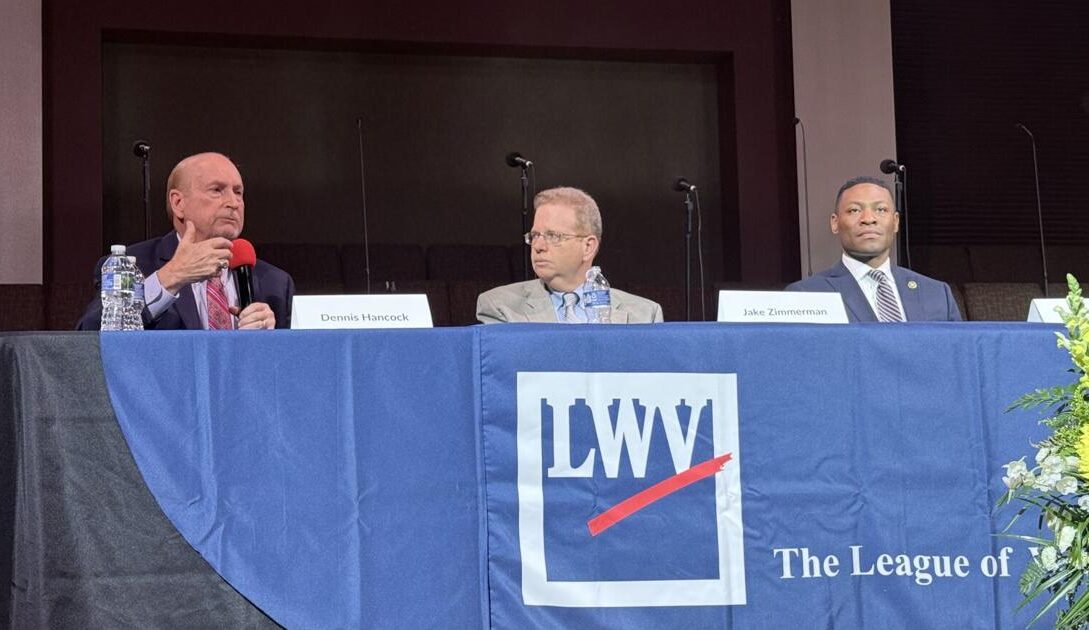
Three contenders for St. Louis County executive—Republican Dennis Hancock, Democrat Jake Zimmerman, and Democrat Brian Williams—addressed their vision for the region at a community forum. (Laura Brown photo)
On June 15, three candidates vying for the position of St. Louis County executive presented their visions for the region at a candidate forum held at Shalom Church in Florissant. The League of Women Voters organized the event ahead of the August 4 primary election. The candidates addressed key issues including economic development, public safety, healthcare, civil rights, and the dynamics between the St. Louis County Council and administration. The position being contested is a single four-year term.
The forum featured Republican County Council member Dennis Hancock from District 3—the only Republican candidate on the August ballot—alongside two Democratic candidates: State Senator Brian Williams and St. Louis County Assessor Jake Zimmerman. Angela Walton Mosley, another Democratic contender, was absent from the event.
Although the three candidates often found common ground on the necessity of economic expansion, effective government services, and improved collaboration among elected officials, they diverged on the methods county government should employ to reach these goals.
Drawing on his 12 years of experience as Fenton’s mayor, Hancock positioned himself as a competence-focused candidate and emphasized basic government functions. He advocated for county government to prioritize delivering core services effectively, maintaining fiscal discipline, and recruiting businesses to generate employment and expand the tax revenue base.
“We need somebody who can bring plain, ordinary competence back to county government,” Hancock said. “You need somebody who knows how to fix potholes. You need somebody who can pick up the trash and plow the streets in the wintertime.”
Zimmerman’s campaign centered on restoring professional standards and eliminating unnecessary political disputes.
“When you think about St. Louis County politics … wouldn’t it be nice if it were a little more boring?” Zimmerman said. “Wouldn’t it be nice if we could stop fighting and squabbling with one another … and instead just focus on doing the work that the people have sent us here to do?”
Williams emphasized his accomplishments as a state legislator, highlighting funding secured for regional initiatives such as the Jamestown Mall demolition, worker skill-building programs, and a regional intelligence center facility. He contended that regional prosperity requires advocating for St. Louis County’s value to the state economy.
“I was proud, as a member of the Missouri Senate, to be sent there as a regional leader, not just a leader for one particular community, and bring back close to $100 million in federal and state funding to this region,” Williams said. “It’s simply because this region makes up 45% of the GDP. We drive the economy for the entire region.”
All three candidates acknowledged that economic development should rank among the county’s primary concerns. Hancock proposed that recruiting and retaining businesses would boost revenue without tax increases. Williams advocated for greater spending on employment initiatives and youth programs, while Zimmerman argued that economic growth must be accompanied by superior administration of county operations. Zimmerman referenced recent issues with the county’s tax payment platform as evidence of management deficiencies.
“Here’s an example of the kind of nuts and bolts issues we should be dealing with,” Zimmerman said, referring to delays and long lines experienced by taxpayers. “To me, that’s a microcosm of exactly the kind of place where we need to start paying better attention and stop focusing so much on the politics.”
Regarding the fair allocation of resources across the county, all three candidates agreed that neglected communities require support, though their strategies differed. Hancock emphasized consistent county service delivery, Zimmerman addressed the lasting consequences of redlining and unequal growth, and Williams referenced funding he has facilitated for underserved North St. Louis County areas, including Kinloch and the Jamestown Mall location.
The candidates addressed the potential for consolidating city and county government. None explicitly supported such a merger. Zimmerman stated that proposals should be judged on whether they enhance resident services and living standards. Williams indicated that stabilizing county finances and improving county operations should take priority before considering consolidation, while Hancock suggested the county must resolve its own difficulties before pursuing wider regional initiatives.
Healthcare policy presented another area of distinction among the candidates. Zimmerman discussed pursuing additional federal assistance for county health clinics, while Williams referenced his background with federally qualified health centers and mental health programs. Hancock recommended that county government encourage private sector participation in underserved communities instead of directly challenging private healthcare enterprises.
The tone intensified when the topic turned to civil rights safeguards. Hancock stressed that government must be welcoming and receptive to input from all communities. Zimmerman objected to what he termed assaults on voting access and representation at the national level, while Williams highlighted bills he has introduced concerning law enforcement conduct, record clearing procedures, and correcting unjust convictions.
The three candidates recognized the fractured relationship between the County Council and the executive’s office and agreed that working together will be essential. Zimmerman emphasized the absence of mutual regard in county government and committed to reducing political acrimony. Williams advocated for leaders to prioritize accomplishments regardless of personality conflicts and cooperate effectively, while Hancock referenced his record collaborating with council representatives across party lines during his municipal tenure.
In their concluding statements, the candidates restated the central messages of their campaigns. Williams stressed that the county requires a leader capable of securing investment and promoting a compelling vision of the region.
“We’re in a very interesting time right now where it’s important to have a leader that knows how to tell our story, that has a vision and, most importantly, has the ability to get things done,” Williams said.
Zimmerman urged for a government characterized by integrity and competence that prioritizes constituents over partisan divisions.
“I hope everybody can feel really good about the fact that no matter what direction we go, there’s a path forward,” Zimmerman said. “There’s an opportunity to make things better.”
Hancock underscored budgetary responsibility, tax reduction, and dependable county services.
“You pay taxes so that you can get the basic services of county government,” Hancock said. “You deserve to have those basic services executed in a timely and efficient manner.”
The triumphant Democrat from the August 4 primary will compete against Hancock and independent candidate J D McFarland in the November general election.