
St. Louis County provided an ideal venue to commemorate America’s 250th anniversary celebration.
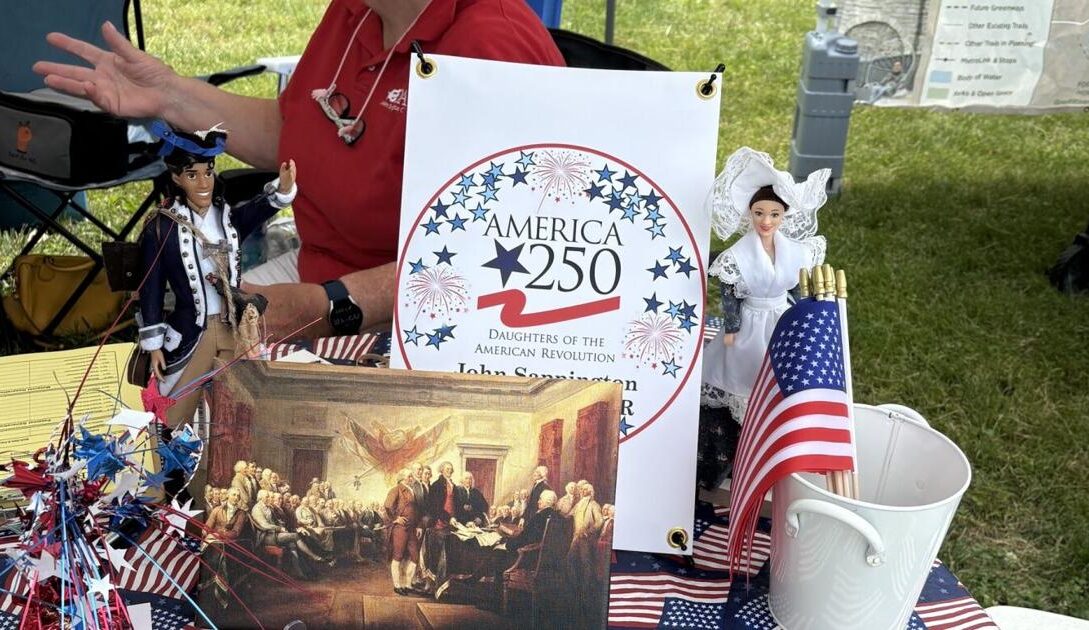
The DAR’s work includes lineage research, historic site restoration and maintenance, and preservation of historical records and artifacts. (Photo by Cathy Lenny)
The St. Louis Area History Showcase was held on June 2 at Jefferson Barracks, which is marking its own 200th anniversary.
Jefferson Barracks collaborated with regional St. Louis history organizations to host the event.
The festival highlighted the distinct heritage, culture and community character of the St. Louis region. Over 60 historic sites, museums, authors and cultural organizations from the region gathered to share their community histories.
Patty Crocker wears period attire in front of the Laborer’s House, constructed in 1851 for workers at the Jefferson Barracks ordnance depot. (Photo by Cathy Lenny)
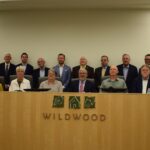
The Wildwood Historic Preservation Commission exhibited displays featuring historic communities including Centaur, Grover and Pond.
Currently underway in Wildwood is the African American Heritage Project along the Monarch-Chesterfield Levee Trail, which features interpretative signage and monuments.
Wildwood is preparing for the centennial celebration of historic Route 66, which traverses Old Manchester Road. (Photo by Cathy Lenny)
Additionally, Wildwood is preparing for the centennial celebration of iconic Route 66, which is located on Old Manchester Road.
A local chapter of the Daughters of the American Revolution (DAR) also participated, focusing on lineage research, restoring and maintaining historic sites, and preserving historical records and artifacts.
Women 18 years and older can become members by proving lineal, bloodline descent from an ancestor who contributed to American independence through military, civil or patriotic service.
John Hyatt displays typical militia uniform from the period, which consisted of hunting shirts, breeches and leather shoes, with hats made of felt or leather. (Photo by Cathy Lenny)
An important mission is the identification and cataloging of unmarked graves belonging to Revolutionary War soldiers.
Similarly, the Sons of American Revolution (SAR) recognizes the patriots of the American Revolution through education and honors acts of heroism and service. Men at least 18 years old can join if they can trace their lineage to a patriot who served or advanced the cause of American independence.
John Hyatt is an active member who participates in reenactments of the Southern Campaign of the American Revolution (1778 to 1781), primarily based in the southern colonies of Virginia, Georgia, North and South Carolina.
The Southern Campaign featured intense fighting, frequently pitting neighbors against each other based on their political allegiances. Loyalists backed the British Crown, while Patriot forces fought for independence from Britain.
The Continental Army enlisted for extended terms and received uniforms, ammunition and rifles from the government, according to Hyatt. They wore blue coats, which stood in stark contrast to the British “redcoats.”
Militia units operated differently, serving as part-time, locally organized forces used primarily for brief military engagements. They supplied their own weapons and wore civilian attire such as hunting shirts, breeches and leather shoes, with hats made of felt or leather.
Hyatt participates in militia reenactments.
“They drove George Washington crazy,” he said. “They had no training; they had no discipline, and they used their own weapons.”
The primary infantry weapon for both regulars and militia from the 13 colonies was the flintlock musket, a muzzle-loading, smoothbore firearm.
The militia augmented the Continental Army.
Under Brig. Gen. Daniel Morgan, the militia were positioned in the front lines, Hyatt explained. They were instructed to fire twice and then retreat behind the Continental Army to reload.
“The British charged up the hill and the Continentals opened fire on them. The militia emerged from behind and defeated him (British officer Banastre Tarleton with the British Legion), even though ‘Bloody Ban’ was known for killing prisoners,” he said.
Eventually, the British were defeated at Yorktown in 1781, bringing major military operations in the war to a close.
“The Southern Campaign won the American Revolution,” Hyatt said. “If we hadn’t won, we’d be flying the Union Flag today.”
The National Museum of Transportation was another organization at the Jefferson Barracks event, featuring one of the world’s largest and finest collections of transportation vehicles.
A current exhibit showcases vehicles from each of the past 10 decades, starting in 1910, celebrating Route 66, according to member Ray Hapak.
A recent addition to the museum is a scale model of the historic SS Admiral.
Built in 1940, the Admiral was the largest inland passenger steamer in America and the first air-conditioned excursion boat.
In the 1980s, Sheet Metal Workers Local 36 apprentices in St. Louis constructed the 20-foot-long model to honor their trade and the boat’s legacy, Hapak explained. With time, it changed ownership and deteriorated.
Museum curator Coby Ellison contacted retired Local 36 members who invested over a year in restoring the model.
The restored 1:20 scale stainless steel model of the Admiral anchors the museum’s new “Roads, River, Rooms and Reels” exhibit, which honors Route 66’s cultural and transportation significance.
The exhibit also highlights the ’66 Park-In Theatre on Watson Road and a restored room from the Coral Court Motel.
“People from all over the world visit this museum,” said David Capell. “It’s a rite of passage.”
The St. Louis Chapter of the National Railway Historical Society also represented the transportation sector, working to advance railroad history, preservation and education. The organization was established in 1935 by rail historians.
A distinctive ride from the past was the 264-foot Observation Wheel at the 1904 World’s Fair. Each full rotation required approximately 15 to 20 minutes.
The World’s Fair commemorated the 1803 Louisiana Purchase, though the celebration was delayed until 1904. St. Louis City Mayor David R. Francis (1850-1927) served as the Fair’s president.
Spanning 1,272 acres, the St. Louis World’s Fair was the largest fair of its time, exceeding the 1893 Chicago World’s Fair by more than double.
To honor this event, the World’s Fair Society was founded in 1986. The organization celebrated the Fair’s centennial in 2004 and recorded interviews with World’s Fair attendees, creating the World’s Greatest Fair documentary.
The St. Louis Genealogical Society also participated, promoting two recently published books – The War of 1812 in Missouri, Volumes one and two, edited by Robert Parkin.
These volumes contain detailed maps, comprehensive bibliographies and thorough indexes. They chronicle the lives of William Clark, Black Hawk and other Native Americans, plus the men who formed the Missouri Rangers before and during the war.
The Cahokia Archaeological Society (CAS) also attended to foster knowledge of archaeology, promote scientific research and safeguard the ancient remains of Mississippian culture. Established in 1972, CAS has been active for over 54 years.
Jefferson Barracks holds special historical importance as the oldest continuously operating U.S. military installation west of the Mississippi River.
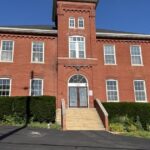
The facility operated as an active military post from 1826 to 1946. Once among the largest and most significant military stations in the nation until the Civil War ended in 1865, Jefferson Barracks served as a preparation and supply hub for all military operations in the western U.S.
Although the post’s role in western military affairs declined in the late 1800s, Jefferson Barracks continued to serve as a critical recruitment and training facility during World Wars I and II.
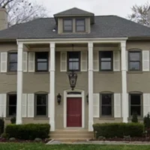
Many original buildings remain on the grounds, including the Laborer’s House, constructed in 1851 for civilians at the Jefferson Barracks ordnance depot. The initial design included two bedrooms upstairs and a spacious communal area downstairs, according to Patty Crocker.
Behind the house stood a detached outdoor kitchen.
The building served multiple purposes before the post closed in 1946. Following St. Louis County’s acquisition of roughly 400 acres of the former post shortly after closure, the house functioned as a St. Louis County Police precinct in the 1950s.
The structure has since been restored consistent with its original design, although the original porch and balcony were not reconstructed.
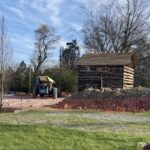
The Ordnance Room was the first of two limestone structures erected at Jefferson Barracks for storing gunpowder. The Powder Magazine Museum, built in 1857, featured 4-foot-thick limestone walls with an arched roof and wooden flooring.
The Civil War Museum memorializes the countless men and women who made the final sacrifice. The National Cemetery, created following the War, serves as the final resting place for service members from all conflicts.